VNA Man-up vs. Man-down: Which is best for your warehouse?
With warehouse space at a premium, Very Narrow Aisle (VNA) trucks are the go-to solution for maximizing storage density. A common dilemma arises: Should you choose a "Man-up" or "Man-down" model?
What is a VNA Man-up Truck?
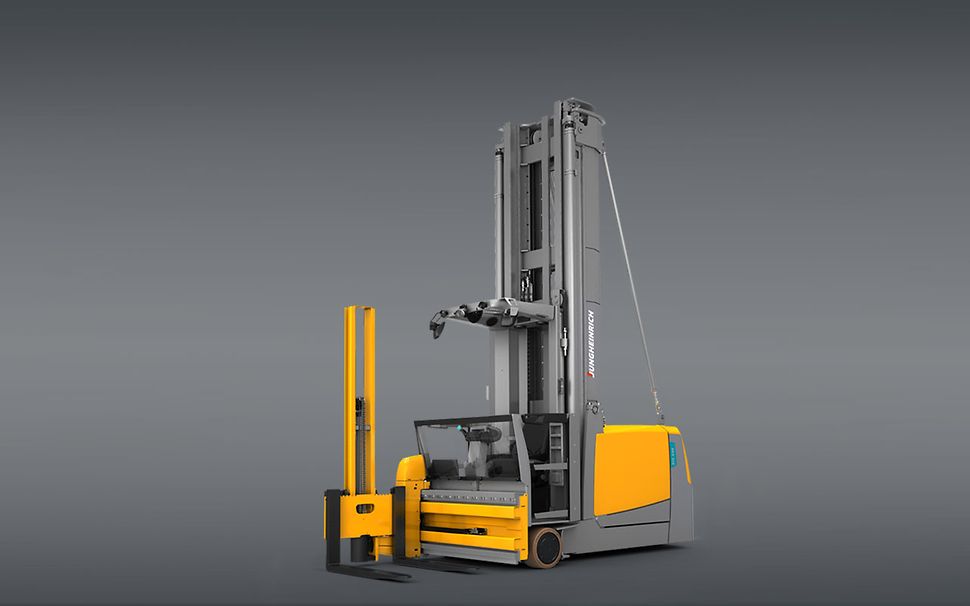
A VNA (Very Narrow Aisle) Man-up truck is an electric forklift designed for warehouses with extremely narrow aisles. Its key feature is that the operator's cabin elevates alongside the forks, allowing the worker to remain at the same level as the rack position at all times.
It eliminates the issue of poor visibility at great heights, which is the leading cause of accidents like dropped goods or rack collisions.
Order Picking
This is the greatest strength, as operators can reach and pick small items directly from pallets at high levels into the cabin, eliminating the need to lower the entire pallet to the ground.
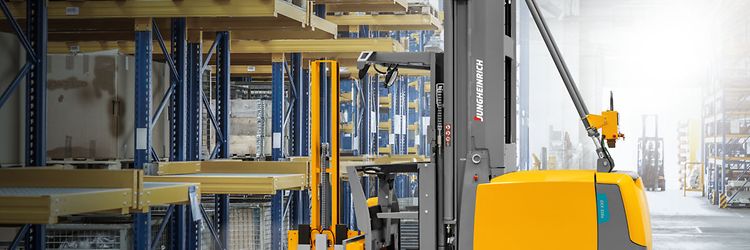
Maximize Space Utilization
This type of truck requires an aisle width of only 1.6 to 1.8 meters, allowing you to increase your warehouse storage capacity by up to 40–50%.
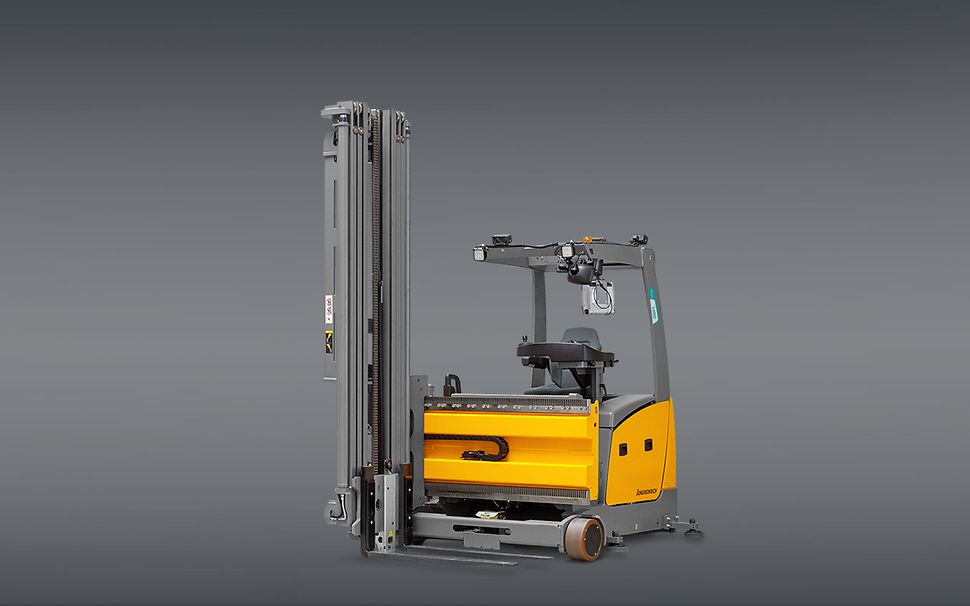
A VNA (Very Narrow Aisle) Man-down truck is an electric forklift designed for high-density warehouses where the operator remains at ground level at all times, even when the forks are elevated to the highest rack level.
Operating Mechanism: While the mast and the load are raised to heights, the operator's cabin stays fixed at ground level. The operator controls pallet placement by viewing from the ground, often assisted by specialized camera systems or digital guidance technology to ensure precision.
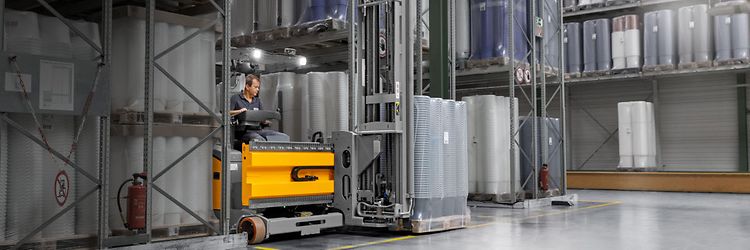
Since the cabin doesn't need to be raised or lowered, the truck can move and prepare for the next pallet as soon as the forks descend, making it generally faster for pure pallet storage and retrieval tasks.
Ease of Use
Operators do not work at heights, reducing fatigue from constant vertical movement. They can also easily exit the truck to handle paperwork or communicate with colleagues, offering greater flexibility.
Comparison: VNA Man-up vs. Man-down
Feature
VNA Man-up (Model EKX 4/5)
VNA Man-down (Model EFX 4)
Operator Position
Elevates with the forks
Stays at ground level
Lift Height
18 meter
9 meter
Picking Method
Direct (Man-to-goods)
Indirect (Remote view)
Visibility
Excellent (Direct view)
Assisted (Camera/Tech required)
Key Factors: Choosing Between VNA Man-up vs. Man-down
Choosing the right VNA truck goes beyond initial costs; you must consider your overall warehouse operations. Here are the 5 key factors to evaluate before investing:
Racking Height
Height is the primary deciding factor:
Choose VNA Man-up for rack heights up to 18 meters. Elevating the operator to the load level minimizes placement errors and ensures optimal visibility.
Choose VNA Man-down for rack heights up to 9 meters, where operators can still effectively gauge distances using CCTV cameras and monitors from the ground.
Operation Type
What do you primarily handle on a daily basis?
Order Picking: If your operations involve picking small items from various pallets at height, Man-up is the only solution. The operator can reach items directly from the pallet into the cabin.
Full-Pallet Handling: If you focus on storage and retrieval of full pallets (Put-away & Retrieval), Man-down models are generally faster and more efficient for operations at medium heights.
Floor Quality
Floor requirements are critical, as VNA trucks operate in extremely narrow aisles and at significant heights:
Precision: Elevated Man-up trucks are highly sensitive to floor unevenness. If the floor does not meet industry standards (such as TR34 or VDMA), it can cause the cabin to sway, creating a safety hazard.
Preparation: Investing in a VNA system may require budgeting for floor grinding to achieve a "Super Flat Floor" to ensure peak performance and safety.
Throughput & Speed
VNA Man-down: Typically offers faster travel speeds and higher cycle efficiency at moderate heights, as it eliminates the time required to raise and lower the operator's cabin.
VNA Man-up: Although overall speed may be slightly slower, it provides a distinct advantage in "placement precision." This reduces the time lost correcting misaligned pallets or dealing with accidents caused by errors.
Elevating Warehouse Efficiency with VNA Solutions
Transitioning to a VNA (Very Narrow Aisle) system is not merely about purchasing new forklifts; it is about transforming your warehouse structure to maximize every square inch of space. The synergy between high-performance VNA trucks and precision-engineered VNA Racking is the key to:
Maximizing Space: Significantly increasing your overall storage capacity.
Boosting Speed: Ensuring immediate access to every single pallet.
Reducing Long-Term Costs: Lowering overheads related to facility rental and minimizing product damage.
Whether you choose VNA Man-up for precision and flexible order picking, or VNA Man-down for high-speed pallet throughput, the most crucial step is selecting a solution that aligns with your specific operational requirements and budget. This ensures your investment is a true leap into the new era of logistics.
It is necessary. Because VNA trucks operate in extremely narrow aisles—often with only a few centimeters of clearance on either side—manual steering by the operator carries a high risk. Therefore, most VNA trucks require a guidance system, such as:
Wire Guidance: A guidance wire embedded beneath the floor.
Rail Guidance: Steel guide rails installed along the base of the racking.
Which one is safer between VNA Man-up and Man-down?
Both types adhere to high safety standards, but they offer different advantages:
Man-up has the edge in precision because the operator has a direct line of sight at the load level, significantly reducing the risk of placement errors at great heights.
Man-down is safer from an operator's perspective, as personnel do not need to work at height, which helps alleviate anxiety or safety concerns for operators who may have a fear of heights.
Is it possible to operate VNA on standard warehouse floor?
No, a standard warehouse floor is typically not sufficient for VNA operations.
Using a VNA truck on a standard floor is highly discouraged and often dangerous. Because VNA trucks operate in extremely narrow aisles with very tight tolerances, the floor must be specially prepared to meet strict "Super Flat Floor" standards.
Is it possible to operate the VNA out of aisle?
It is possible, but not recommended for long distances or for direct transfer of goods from trucks. The wheels of a VNA truck are specifically designed for the perfectly flat surfaces within narrow aisles, and the truck has a very specific turning radius. Its primary role is to handle the storage and retrieval of goods within the racking area, typically using a dedicated Staging Area (P&D station) for hand-offs.